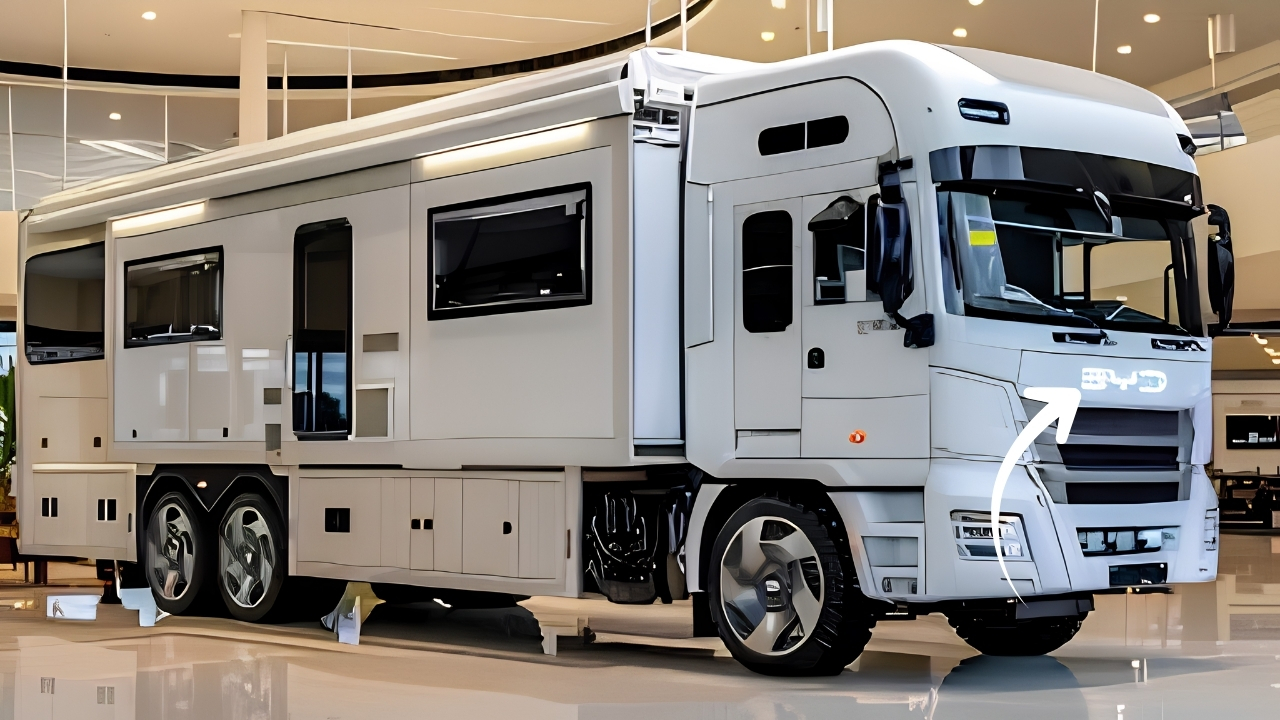
2026 BYD Motorhome : The idea of a BYD motorhome has become one of the most discussed topics in the global RV community during 2026. For American travelers, the excitement is understandable.
Electric and hybrid technology is moving beyond cars, pickups, and delivery vans into vehicles designed for long-distance living. A motorhome that combines battery power, solar support, and a range-extending engine could reshape how people think about road trips, campground stays, and off-grid travel.
However, there is an important distinction for U.S. readers: the motorhome attracting attention is not a confirmed, mass-market BYD RV officially available through American dealerships.
Much of the conversation centers on a Chinese-built coach based on BYD’s T5DM hybrid commercial-vehicle platform, with the living space created by a separate RV manufacturer.
That makes it less of a traditional “BYD motorhome” and more of an example of how BYD’s technology may influence the next generation of recreational vehicles.
The T5DM Platform Behind the Headlines
The vehicle at the center of the discussion is a compact motorhome built on BYD’s T5DM platform. Unlike a conventional diesel-powered Class C camper, the basic concept uses an electrified drivetrain.
Reports describe a setup in which electric propulsion does the driving, while a small gasoline engine can operate as a generator to extend travel capability when charging is unavailable.
That approach may appeal to RV owners who like the quiet, immediate response of electric driving but are not ready to rely entirely on public charging stations. In the United States, this is a practical concern.
A typical cross-country RV trip can include long rural stretches, national-park routes, mountainous terrain, and campgrounds with limited electrical infrastructure.
A range-extender system could give drivers more flexibility than a battery-only motorhome, especially during early years of electric RV adoption.
The BYD-based motorhome also represents a different way of thinking about energy. Instead of treating the vehicle battery, house battery, rooftop solar panels, and generator as separate systems, the design aims to connect them more closely. That could allow the vehicle to manage energy more efficiently during travel and while parked.
Off-Grid Living Without Propane
One of the biggest talking points around the BYD-based motorhome is its all-electric living area. Traditional American RVs commonly depend on propane for cooking, heating, refrigeration, and sometimes water heating.
The newer design highlighted in China reportedly relies more heavily on induction cooking, battery storage, solar generation, and electric appliances.
For travelers, the attraction is straightforward. An electric kitchen eliminates the need to monitor propane levels or carry fuel cylinders. It may also reduce concerns related to open flames and gas leaks inside a compact vehicle.
Solar panels can help recharge the house system while parked, supporting lights, electronics, refrigeration, and small appliances without constantly running an external generator.
This does not mean the motorhome is fully independent of fuel or charging. The range-extending engine still uses gasoline, and solar output varies sharply by weather, season, shade, and location.
Still, the concept shows how RV manufacturers could gradually reduce propane dependence while improving the comfort of off-grid camping.
For U.S. campers, this could be especially appealing in places where generator noise is restricted or unwelcome. Quiet power is one of the strongest potential advantages of battery-supported RV living.
A family spending a night near a trailhead, a lake, or a remote desert campsite may prefer the sound of wind and wildlife over the constant hum of a generator.
What the Interior Could Mean for RV Buyers
The BYD-based motorhome is reportedly built around a relatively compact coach layout, with sleeping space for two people and integrated facilities for cooking, washing, and resting.
That format fits a growing part of the American RV market: travelers who want mobility and comfort without driving a huge bus-style motorhome.
The key selling point is not simply luxury. It is integration. Modern RV buyers increasingly expect their vehicles to function as mobile offices, weekend cabins, and self-contained travel homes.
That means dependable power for laptops, phones, cameras, connectivity equipment, climate systems, and kitchen appliances. A stronger electrical system can make those uses easier without requiring constant hookups.
For retirees, remote workers, couples, and small families, the appeal of a smaller electrified motorhome is clear. It could be easier to maneuver, less intimidating to park, and better suited to destinations where large RVs are inconvenient.
The challenge will be proving that advanced power systems can handle the heavy demands of air conditioning, heating, refrigeration, and long driving days in real American conditions.
Why U.S. Availability Remains Uncertain
The biggest question for Americans is simple: will a BYD motorhome actually come to the United States? At present, there is no confirmed launch plan for this specific BYD-based RV in the U.S. market.
The vehicle has been discussed primarily as a Chinese-market product built around a BYD commercial chassis, not as a U.S.-certified motorhome sold through an American dealer network.
Bringing such a vehicle to the United States would involve far more than shipping it across the Pacific. It would need to meet federal vehicle-safety rules, emissions requirements where applicable, and RV-specific standards.
Service access, replacement parts, warranty support, software compliance, and charging compatibility would also matter to buyers.
Trade policy is another major obstacle. The U.S. has imposed substantial tariffs on Chinese electric vehicles, and restrictions affecting Chinese-connected vehicle technology have added more uncertainty to the market.
These issues make a direct U.S. launch difficult even if there is strong interest from consumers.
A Signal for the Future 2026 BYD Motorhome
The real importance of the BYD motorhome story may not be whether this exact vehicle arrives in America next year. Its importance is that it illustrates where the RV industry could be heading.
Hybrid propulsion, high-capacity batteries, solar support, electric appliances, and digitally managed energy systems are becoming more relevant as travelers look for quieter and more flexible ways to explore.
American RV manufacturers are likely watching closely. The United States has a deep camping culture, extensive highway networks, and millions of RV-owning households. Those strengths make the country a natural market for electrified motorhomes, but the transition will take time.
Charging infrastructure must improve, vehicle weights must remain practical, and buyers need confidence that repairs can be handled far from home.
For now, the BYD-based motorhome is best viewed as a technology story rather than a ready-to-buy U.S. product. It offers a glimpse of a future in which an RV can drive electrically, generate and store its own power, reduce its reliance on propane, and make off-grid travel more comfortable.
Also Read this – Nokia X50 5G – 120Hz smooth display smartphone with dhansu design, storage is 1TB
Whether BYD itself enters the American motorhome business or not, the ideas behind this vehicle are likely to influence the RVs Americans see in the years ahead.