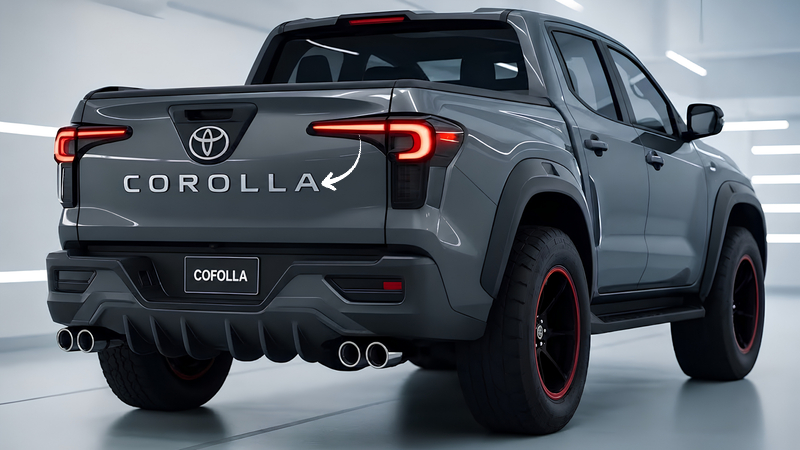
2026 Toyota Corolla Pickup Mini truck : Toyota has officially confirmed a compact Corolla-based pickup. It is called the Corolla Deck, not a “2026 Corolla Pickup,” and it is meant for Latin America and the Caribbean, not the United States.
A Reveal in Brazil
Toyota showed the truck on November 18 at the opening of its second Sorocaba factory in São Paulo state, known as Sorocaba 2. The plant will build the pickup and ship it across Latin America and the Caribbean.
It is also the first new model to come out of the facility. For months, a camouflaged prototype had been spotted on Brazilian roads, so the announcement settled a long-running rumor.
Some web articles still describe a “2026 Corolla mini truck” as if it were on sale. It isn’t. Production is expected to start in the first half of 2027, and some reports point to a launch window between April and June.
Design and Underpinnings
The Deck is essentially a Corolla Cross with a bed. It keeps the familiar nose of the crossover but stretches the rear into a four-door, five-seat layout with a short cargo bed.
Toyota reworked the side and rear profile for the job. The truck gets new LED taillights, new rear fenders and a redesigned rear window.
It uses a unibody structure instead of a traditional body-on-frame setup. That makes it closer to the Ford Maverick and Hyundai Santa Cruz than to a Tacoma.
Toyota also replaced the crossover’s rear torsion beam with a multi-link rear suspension. That change is meant to give the truck a smoother, more controlled ride.
Powertrain: What We Know
Toyota has not released full specifications. The truck on display wore XRX trim, which is the top Corolla Cross level in Latin America. It also carried an HEV badge on the tailgate. That strongly suggests the 1.8-liter flex-fuel hybrid system used in the Brazilian Corolla and Corolla Cross.
In those models, the engine pairs with an electric motor and a small battery. Together they produce about 122 horsepower and send power to the front wheels through an e-CVT.
Some outlets think a conventional 2.0-liter engine could join later, and others wonder about all-wheel drive. Neither has been confirmed. Payload and towing figures are also missing, so any claim that the Deck beats or loses to rivals is premature.
Why Americans Are Left Out
Several outlets asked Toyota about a U.S. launch. Toyota has not announced one. Car and Driver, Road & Track and AutoGuide all reported the same thing: no word on American availability. TFLcar points out that this doesn’t prove the truck will never come here.
There is real interest inside Toyota in a small U.S. pickup. Toyota Motor North America’s CEO has said the company is eyeing the compact unibody segment, and he named the larger RAV4 as the likelier starting point.
Another Toyota executive said in 2025 that a small truck was “not a matter of if.” Even so, no timeline exists. Some commentators also doubt that a Corolla Cross-sized pickup with 122 horsepower would suit American buyers.
The Scion Kei-01 Is Coming Instead
Americans will get a different tiny Toyota truck. The revived Scion brand will offer the KEI-01, a kei-style pickup just over 11 feet long. It has a 660cc gasoline engine, four-wheel drive and a 25 mph top speed.
Assembly is planned for Indiana from the second half of 2027. It will start as a limited, fleet-focused pilot program aimed at farms, construction crews and commercial users, not everyday commuters.
The Kei-01 and the Corolla Deck are very different trucks. One is a low-speed utility vehicle. The other is a family-friendly hybrid with a real bed.
What to Watch Next
Three things will clarify the Deck’s story. First is the full spec sheet, including output, payload and towing. Second is the exact on-sale date in Brazil. Third is any sign from Toyota North America about a separate U.S. pickup.
Also Read this – Vivo 5G Smartphone Camera is 250MP, battery is 7600mAH, Fast Charging in just 20 Minutes
Until then, treat “2026 Toyota Corolla Pickup” headlines with caution. The real vehicle is the Corolla Deck, it is confirmed, and it is coming in 2027, but only to markets outside the United States.