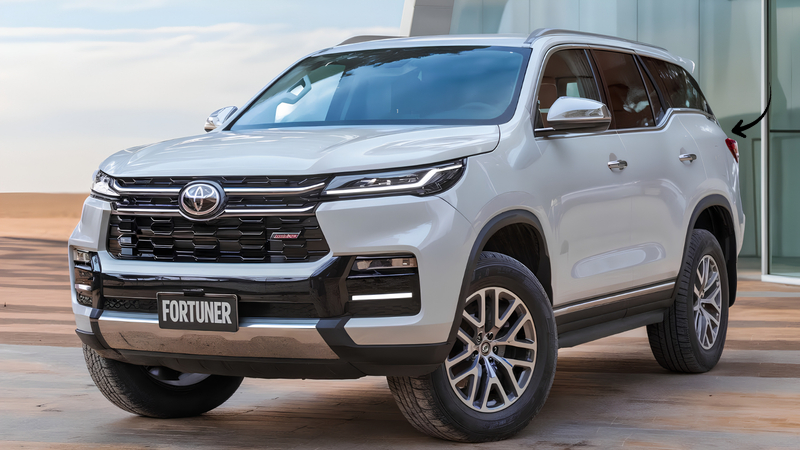
2026 Toyota Fortuner New Facelift : The Toyota Fortuner has always occupied a special place in India’s SUV market. It is not merely a vehicle; for many buyers, it represents presence, dependability, and the confidence to travel beyond smooth city roads.
Now, with the next major update expected to break cover globally on December 1, 2026, the Fortuner appears ready for its most meaningful transformation in years.
Reports and spy-based reports suggest a sharper exterior, a modernised cabin, advanced safety technology, and continued focus on diesel performance.
Why the Fortuner Update Matters
Toyota has kept the Fortuner relevant for a long time through steady updates rather than frequent complete redesigns. That approach has worked because the SUV’s core appeal has remained unchanged: a tall, commanding stance, a rugged ladder-frame chassis, strong diesel torque, and genuine off-road ability.
However, the premium SUV segment has changed considerably. Buyers now expect large touchscreens, digital displays, connected-car features, driver-assistance systems, and a cabin that feels closer to a modern luxury SUV.
The upcoming Fortuner is expected to respond to exactly those expectations while retaining the qualities that made it popular in the first place.
Global Debut Expected Soon
The new Fortuner is widely expected to make its global debut on December 1, 2026, in South Africa. For Indian buyers, the more important detail is the expected launch timeline: industry reports indicate that the updated SUV could arrive in India during 2027.
That gap between the global reveal and the Indian launch is not unusual. Toyota generally adapts its models for local market requirements, including variant structure, features, powertrain choices, and safety equipment.
Still, the approaching debut has created considerable excitement because the Fortuner has remained a dominant name in the full-size SUV space for years.
A Bolder Exterior Design
The most visible change will be the exterior. Camouflaged test vehicles and reported design details point towards a more aggressive front end, likely with a revised grille, new lighting elements, and a redesigned bumper. The idea appears to be simple: make the Fortuner look even more imposing without losing its familiar SUV character.
The Fortuner’s upright silhouette is likely to remain, because it is central to its identity. Buyers choose it partly for its road presence, high driving position, and ability to look substantial in traffic.
A facelift that softened those traits too much would risk alienating loyal customers. Instead, the update seems designed to modernise the SUV’s appearance while preserving its tough, commanding personality.
Cabin Could Feel Far More Modern
The interior is where the new Fortuner may see the biggest practical improvement. Reports suggest a 12.3-inch touchscreen infotainment system and a 12.3-inch fully digital instrument cluster.
If Toyota carries both displays into the production version, the cabin will feel substantially more contemporary than the current model.
Other expected features include ventilated and powered front seats, a 360-degree surround-view camera, and Level 2 advanced driver-assistance systems. These additions would bring the Fortuner closer to newer rivals that have already made technology a major selling point.
The challenge for Toyota will be to make the cabin feel premium without making it complicated. Fortuner buyers often value physical controls, durability, and straightforward usability, especially those who use the vehicle for long highway journeys or rough-road travel. A balance between touchscreen convenience and practical controls will be important.
Safety May Become a Major Focus
Safety is likely to be one of the most significant upgrades. The expected Level 2 ADAS package could include features such as adaptive cruise control, lane-keeping assistance, automatic emergency braking, and other driver-support functions.
This would be an important step for a vehicle that is often used for family travel, long-distance highway driving, and off-road trips. Modern safety technology does not replace driver attention, but it can reduce fatigue and provide additional support in demanding traffic conditions. For a large, heavy SUV, such systems can be particularly useful during long journeys.
Engines Likely to Remain Familiar
Despite the visual and technological changes, Toyota appears likely to retain the proven mechanical foundation. The updated Fortuner is expected to continue with the 2.8-litre turbo-diesel engine, paired with the 48V Neo Drive mild-hybrid system. This setup is reported to produce around 201 bhp and 500 Nm of torque in the top-spec 4×4 version.
A 2.7-litre petrol engine is also expected to remain part of the lineup. Transmission options may include six-speed manual and six-speed torque-converter automatic gearboxes, along with low-range four-wheel drive for serious off-road use.
This continuity makes sense. The Fortuner’s diesel engine has built a reputation for torque, durability, and long-distance capability. Rather than replacing it with an entirely new powertrain, Toyota seems focused on improving efficiency and refinement through mild-hybrid assistance while retaining the rugged mechanical character.
What Indian Buyers Can Expect
Indian customers will closely watch the variant strategy. The Fortuner has traditionally been offered in multiple configurations, including petrol and diesel options, two-wheel-drive and four-wheel-drive versions, and a range of trim levels. The updated model is expected to continue offering petrol, diesel, and mild-hybrid powertrain choices.
The biggest question will be feature distribution. If Toyota offers the larger screens, ADAS, powered seats, and surround camera across more variants, the new Fortuner could become far more competitive.
If these features remain limited to top-end versions, the entry-level models may still feel dated despite the exterior update.
Competition Will Be Tough
The Fortuner will face strong competition from established rivals and newer premium SUVs. Buyers in this segment now compare vehicles not only on engine capacity and off-road ability, but also on cabin quality, safety technology, ride comfort, and ownership experience.
Toyota’s advantage remains its brand trust and the Fortuner’s strong reputation for reliability. The upcoming update could strengthen that position by addressing the areas where rivals have moved ahead, particularly interior technology and driver assistance.
Final Take
The 2026 Toyota Fortuner facelift looks set to be more than a cosmetic refresh. With an expected global debut on December 1, 2026, and a likely India arrival in 2027, the SUV could combine its familiar rugged strengths with a much-needed dose of modern technology.
Also Read this – Nokia 1100 5G Keypad Smartphone is launched with 220MP Camera, battery is 6800mAh, Check the price
If Toyota delivers the reported dual 12.3-inch displays, Level 2 ADAS, improved comfort features, and the trusted 2.8-litre diesel mild-hybrid powertrain, the Fortuner may retain its position as one of the most desirable full-size SUVs in India. The core formula appears unchanged, but the execution could finally match the expectations of today’s premium SUV buyer.